

Created by Matt Zoller Seitz
Directed by Judith St. Germain
“If you only read the books that everyone else is reading, you can only think what everyone else is thinking.”
Haruki Murakami
Photo by chun kit wong on Unsplash
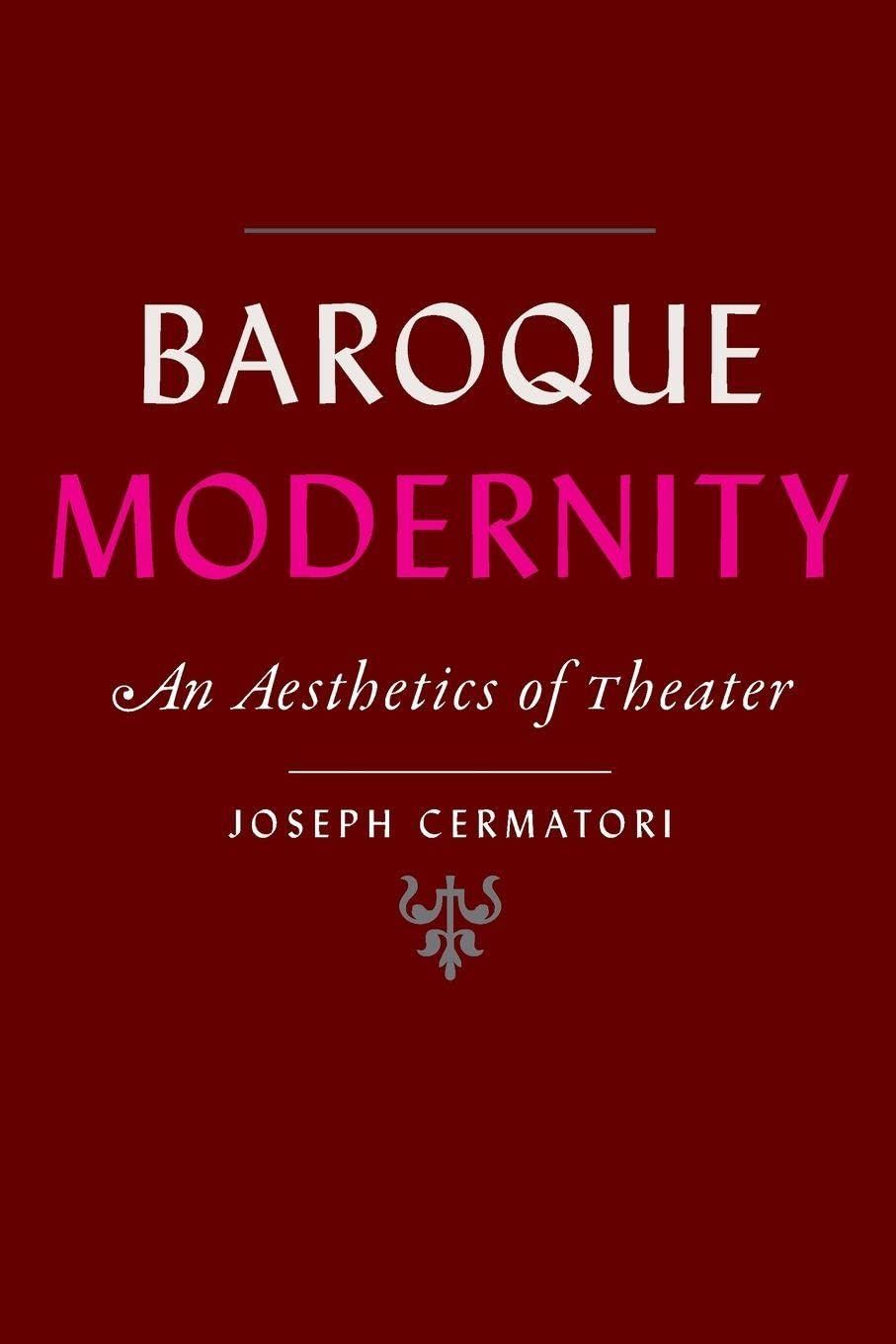
The book focuses on avant-gardists whose writing takes place between theory and performance: philosophical theater-makers and theatrical philosophers including Friedrich Nietzsche, Stéphane Mallarmé, Walter Benjamin, and Gertrude Stein. Moving between page and stage, this study tracks the remnants of seventeenth-century theater through modernist aesthetics across an array of otherwise disparate materials, including modern opera, Bertolt Brecht's Epic Theater, poetic tragedies, and miracle plays. By reexamining the twentieth century's engagements with Gianlorenzo Bernini, William Shakespeare, Claudio Monteverdi, Calderón de la Barca, and other seventeenth-century predecessors, the book delineates an enduring tradition of baroque performance. Along the way, Cermatori expands our familiar narratives of "the modern" and traces a history of theatricality that reverberates into the twenty-first century.
Baroque Modernity will appeal to readers in a wide array of disciplines, including comparative literature, theater and performance, art and music history, intellectual history, and aesthetic theory.
REVIEWS
"This wondrous work shows that modernism has been mistakenly and consequentially contrasted with the baroque in the service of a secularization narrative and a progressive narrative of periodization. The florid pre-history of spare modernism turns out never fully to fall away and, in Cermatori's splendid account, even the queer theoretical distinction between performative speech acts and theatricality turns out to be a result of that disavowal―and return―of the baroque. A brilliant and unsettling book!" — JUDITH BUTLER, University of California, Berkeley, author of The Force of Non-Violence: An Ethico-Political Bind
"Cermatori's book has the advantage of proceeding from a fact that is both readily acknowledged and traditionally undertheorized: that the quality of being 'baroque' still exerts tremendous conceptual thrall over the aesthetic production of modernity. Baroque Modernity is a deeply necessary and timely intervention―a genuine tour de force." — ADRIAN DAUB, Stanford University, author of Four-Handed Monsters: Four-Hand Piano Playing and Nineteenth-Century Culture
"Highly intelligent, lucid, and elegantly wrought, Baroque Modernity enlivens the history it describes and speaks to epistemological concerns. Cermatori has a good eye and ear for the languages of the stage, amply demonstrated in his discussion of baroquely modernist spectacle, a counter-Wagnerian take on total theater." — SPENCER GOLUB, Brown University, author of Heidegger and Future Presencing (The Black Pages)
"Revelatory in both local detail and overall conception, Baroque Modernity realigns theatrical modernism's relationship to its past. It also secures its future place of importance in the renovated scholarship on modernism writ large. Four deeply researched case studies—of Nietzsche, Mallarmé, Benjamin, and Stein—anchor a broad range of expansive insights into modernism's insufficiently acknowledged 'pro-theatricality,' and Joseph Cermatori has written them in a compelling style that evokes the aesthetic qualities of the baroque itself—expressive, complex, daring, exuberant, and epiphanic." — JOSEPH ROACH, Yale University, author of Cities of the Dead: Circum-Atlantic Performance
ABOUT THE AUTHOR
Joseph Cermatori is a writer, editor, critic, translator, and historian. He teaches and publishes in the fields of comparative literature, modern and contemporary drama, performance studies, and critical theory. In addition to his primary research interest in twentieth-century modernism, his scholarship encompasses the broad history of art and ideas in Western culture from 1600 to the present, focusing on the philosophical content of artistic and creative forms. Currently he is associate professor of English at Skidmore College in Saratoga Springs, New York, where he is affiliated with the department of theater and the program in gender studies. In recent years his work has been supported with awards and fellowships from the Yale University Beinecke Rare Book and Manuscript Library (2022, 2008), the U.S. Department of Education (2011–15), the Columbia University Marion Ponsford Fellowship Fund (2016), the American Comparative Literature Association (2021), and through his participation with institutes for advanced research at Northwestern University (2009) and Harvard University (2012).
MZS.Press is the online arts bookstore founded by author, critic, and filmmaker Matt Zoller Seitz and Directed by Judith Carter. It offers new, used, signed, collectible, and rare books on film, TV, music, photography, and the visual arts. The store was launched in 2019 on a different platform and has expanded to incorporate arts books published by MZSPress's private imprint: titles currently include Seitz's The Deadwood Bible: A Lie Agreed Upon and Dreams of Deadwood, about the HBO Western, and Walter Chaw's A Walter Hill Film.
Our deepest wish is to promote, encourage, and distribute work by small presses, academic presses, and individuals. Extraordinary work tends to get swallowed up on giant platforms like Amazon and Barnes & Noble. The titles featured here are personally selected by a group of curators and advisors, including Seitz and an array of critics, artists, journalists, educators, publishers, and arts mavens who are known for their ability to suss out what Seitz's jazz musician dad liked to call "the good sh*t."
"I don’t dream at night, I dream at day, I dream all day; I’m dreaming for a living,"
~Steven Spielberg
And MZS when I ask "what are you doing?"

Matt Zoller Seitz
Critic, Author, Filmmaker, MZS Press Creator
Matt Zoller Seitz is the Editor at Large and film critic of RogerEbert.com; Former Features Writer for New York Magazine and Vulture.com, Contributing Writer for D Magazine and Texas Highways as well as finalist for the Pulitzer Prize in criticism. His writing on film and TV has appeared in Sight and Sound, The New York Times, Salon.com, The New Republic and Rolling Stone. Seitz is the founder and original editor of the influential film blog The House Next Door, now a part of Slant Magazine.
Seitz has written, narrated, edited or produced over a hundred hours’ worth of video essays about cinema history and style for The Museum of the Moving Image, Salon.com and Vulture, among other outlets such as Texas Highways and AARP. His five-part 2009 video essay Wes Anderson: The Substance of Style was spun off into the hardcover book The Wes Anderson Collection. This book and its follow-up, The Wes Anderson Collection: Grand Budapest Hotel were New York Times bestsellers.
Other Seitz books include the New York Times bestsellers The Sopranos Sessions and Mad Men Carousel; TV (The Book), The Deadwood Bible: A Lie Agreed Upon, The Wes Anderson Collection: The French Dispatch and the new The Wes Anderson Collection: Asteroid City. He is also an interviewer, moderator, and film programmer who has curated and hosted film and TV presentations for the Museum of the Moving Image, IFC Center, San Francisco's Roxie Cinema, and other venues. In October 2024 he brought the legendary filmmaker Oliver Stone back to Dallas for a historic return to the city and the Texas Theatre, considered the biggest film event of Dallas in 2024 by Dallas Observer!
Judith St. Germain was in the Upscale and Luxury Hospitality Industry for most of her life. In 2004 she had a beautiful baby boy with Special Needs and put the pause on her career until 2017 to dedicate herself to him and then others, assisting and volunteering as a legal advocate ensuring the best medical care, evaluations and educations for Special Needs children and their families.
Matt and Judith were family friends for over 20 years. She was there with her family in support when his wife Jen passed away suddenly in 2006. Then just 6 weeks later while Matt was in Dallas; he and his Father, Dave, and Step-Mother, Genie, were there as support, when Judith was alone and her son received the first of many diagnoses that changed the trajectory of their lives. So it made sense in the turbulent year of 2020, Matt asked Judith to take over running the online store that has become MZS.press. The rest as they say is, "Their"-story.